Among the other assorted pieces of junk mail waiting for me on my return from down south was this fluff piece from a recruiting firm I know. Well titled but absent much related substance, it's an interview with the last (as in, there won't be any more) CEO of a small public company I ran a few years ago.
It reads like the story of a traffic cop who shows up late to the scene of a head-on and looks for lessons in being a traffic cop, not the head-on.
Which is unfortunate because there are some important lessons about the plight of small caps everywhere.
The first is you don't want to be one. Being a small cap is like running a weather station in the arctic. A few people find your signals interesting but overall, being a small cap means being irrelevant. Which is why if you've made the mistake of becoming one, you'd better have or figure out a way (grow fast or sell) to not be one. Fast.
Secondly, learn to market and sell. In this case the company went public because they needed the cash. They needed the cash because they were way more comfortable inventing new stuff instead of selling what they had. When that happened....when they did start selling what they had...growth and profitability were easy.
Thirdly, it's way better being a company with a unique product that solves a customer need, than being a company with a unique core competency in search of a customer need. In this case - driving laser beams is cool, but the profitable, untapped market applications are all niches, not mass markets...meaning a never-ending search for more places to apply the core competency.
Ultimately, management made the fatal mistake of chasing a saturated, low margin mass-market that sealed its fate.
Finally, bad governance kills - whether you're Goldman Sachs or a company few people have heard of. The governors in this case made a series of questionable calls. A key one was not recognizing early on that selling the company was a legitimate option for creating shareholder value. Ultimately, that is exactly what happened, but years later and at gunpoint/low value. Ultimately, its not clear management or the Board ever recognized the reality of the company's capabilities, it's markets or of being public.
Bottom line. Small caps face the same challenges as all small companies but RUN differently because they're public. For companies who haven't mastered the basic challenges, dealing with the differences can be a killer.
Showing posts with label Canadian. Show all posts
Showing posts with label Canadian. Show all posts
Monday, December 22, 2008


Monday, October 27, 2008
Funny Money
For my friend, who asked a great question about why the Canadian dollar has fallen back off the Scarborough Bluffs into Lake Ontario - here's some insight from commenters at the Globe and Mail. They make as little or much sense as anyone else who's taking stabs at an explanation.
"Given our productivity, other than selling our resources, we have little to offer. Thus, our dollar is falling to where it should. Even our vaunted surplus is disappearing faster than we can blink as the drop in commodity price hits all aspects of government revenue (consumption taxes, corporate taxes, royalties, etc.), and has negative spin off effects into the general community which will only further drop government revenue. Lastly, our exports will fall and, since we produce nothing ourselves, imports will fall slower." b W from Canada
"I like the widespread denial in Canada and the Pavlovian response on blaming US. Housing bubble in Canada is as bad as in US, just read the other day that prices in New Foundland appreciated 30% in the last year, leave alone SK...Banks are not in better shapes, some of them CIBC and TD made their bets in US, too. Wait until, house prices drop significantly in Canada and all those mortagages become sour. The really abberation was having the CAD$ appreciating from 0.63 to 1.10 from 2002 to 2007. The CAD$ is reverting back to the mean, sometimes overshoots on its way down or up." FLORIN ARSENE
"Currency may regain its vitality quickly after funds stop buying U.S. dollars, yen to cover short positions, CIBC's Shenfeld says"
So, the reason why the US dollar is going is because of demand.
Not exactly reassuring, seeing as it implies a lot of trader are getting caught short (HA!) out there, but at least it's an explanation.
ie: not capital flight to security, but capital repatriation to cover the bills. Tiu Leek from Here
"Given our productivity, other than selling our resources, we have little to offer. Thus, our dollar is falling to where it should. Even our vaunted surplus is disappearing faster than we can blink as the drop in commodity price hits all aspects of government revenue (consumption taxes, corporate taxes, royalties, etc.), and has negative spin off effects into the general community which will only further drop government revenue. Lastly, our exports will fall and, since we produce nothing ourselves, imports will fall slower." b W from Canada
"I like the widespread denial in Canada and the Pavlovian response on blaming US. Housing bubble in Canada is as bad as in US, just read the other day that prices in New Foundland appreciated 30% in the last year, leave alone SK...Banks are not in better shapes, some of them CIBC and TD made their bets in US, too. Wait until, house prices drop significantly in Canada and all those mortagages become sour. The really abberation was having the CAD$ appreciating from 0.63 to 1.10 from 2002 to 2007. The CAD$ is reverting back to the mean, sometimes overshoots on its way down or up." FLORIN ARSENE
"Currency may regain its vitality quickly after funds stop buying U.S. dollars, yen to cover short positions, CIBC's Shenfeld says"
So, the reason why the US dollar is going is because of demand.
Not exactly reassuring, seeing as it implies a lot of trader are getting caught short (HA!) out there, but at least it's an explanation.
ie: not capital flight to security, but capital repatriation to cover the bills. Tiu Leek from Here
Wednesday, October 22, 2008
So much to do, so little chance of it all working
It's planning time again. Many organizations are heads down, working on getting their acts together for next year.
This year, there isn't as much confidence in simply winging it as there was last year. Little if any of the grandiose growth that was supposed to happen in '08 has occurred. Combine that with an unstable economic outlook for '09 and there's recognition that getting it wrong next year could have serious, if not fatal consequences (although in true Canadian fashion, all the CFO's I know are silently/not-so-silently high-fiving themselves on the decline of the Canadian dollar. That, more than anything is going to save a few jobs this year).
There's one fundamental issue every organization I know seems to struggle with. Defining, the small number of priorities that will actually make a difference in the year ahead.
Nothing stymies success like taking on the world of things that could possibly be done. First, tackling everything just about guarantees that nothing gets done. Second, when everybody is doing everything, accountability is impossible. Third, by tackling everything the high leverage activities remain invisible, under-resourced and untapped.
Figuring out the 3 things that WILL make a difference next year, not the 57 that COULD, isn't difficult. I try to keep the following things in mind.
This year, there isn't as much confidence in simply winging it as there was last year. Little if any of the grandiose growth that was supposed to happen in '08 has occurred. Combine that with an unstable economic outlook for '09 and there's recognition that getting it wrong next year could have serious, if not fatal consequences (although in true Canadian fashion, all the CFO's I know are silently/not-so-silently high-fiving themselves on the decline of the Canadian dollar. That, more than anything is going to save a few jobs this year).
There's one fundamental issue every organization I know seems to struggle with. Defining, the small number of priorities that will actually make a difference in the year ahead.
Nothing stymies success like taking on the world of things that could possibly be done. First, tackling everything just about guarantees that nothing gets done. Second, when everybody is doing everything, accountability is impossible. Third, by tackling everything the high leverage activities remain invisible, under-resourced and untapped.
Figuring out the 3 things that WILL make a difference next year, not the 57 that COULD, isn't difficult. I try to keep the following things in mind.
- Perfection isn't necessary. If I'm close to picking the right 3 priorities, I will have have a much greater impact on the business by executing them well than burying the perfect priority under 56 others.
- Leverage, leverage, leverage. I call them super-priorities. Do them well and they will suck up 2/3rds of all the other cool stuff that could have been done. There's always priorities that have leverage way beyond what they look like on the surface.
- Why? What is the overall goal I'm trying to achieve? Growth? Profitability? Market place recognition? Everything else needs to tie directly, and neatly back to that goal. If it doesn't and if the question 'why?' can't be answered simply in about 6 words, then the priority isn't a priority, it's a make work project. Guaranteed it won't get done.
Subscribe to:
Posts (Atom)
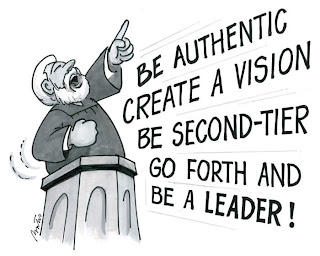
Leadership Smeadership
Okay. I know it’s a settings thing. Sometime, a long, long time ago – probably when leadership was being invented – I must have indicat...
-
 In 2012 I've attended two HR conferences. They couldn't have been more different. The 2nd Annual Talent Management Development C...
 -
 Last night I got to have dinner with a group of 20 CIO’s. My role was to help bring the CEO perspective to them on what they do and h...
 -
 Okay. I know it’s a settings thing. Sometime, a long, long time ago – probably when leadership was being invented – I must have indicat...